Alp Akdaş, Director of Production and Operations at Dinamik Isı Yalıtım A.Ş., stated that the true performance of insulation materials should be assessed not only by the technical values a product has on day one, but also by how well it can maintain those values over the years. Highlighting the importance of long-term performance in terms of energy efficiency, condensation control and sustainability, Akdaş emphasized that the right material, the right insulation thickness and the right application must be considered together.
Technical parameters such as thermal conductivity, water vapor diffusion resistance, density, fire classification and operating temperature are of great importance in evaluating the performance of insulation materials. However, how long an insulation system that operates for years under real operating conditions can maintain its performance is becoming an increasingly important evaluation criterion.
Commenting on the subject, Alp Akdaş, Director of Production and Operations at Dinamik Isı Yalıtım A.Ş., stated that the concept of long-term performance should be given more attention in the insulation industry, and said:
“The performance of insulation materials is often evaluated on the basis of the values given in technical data sheets. Parameters such as thermal conductivity, water vapor diffusion resistance, density, fire classification and operating temperature are undoubtedly of great importance in choosing the right product. However, we believe another very important question also needs to be asked: To what extent can an insulation system maintain its initial performance over the years?”
Real Operating Conditions Differ from the Laboratory
Noting that in practice insulation materials face far more variable conditions than in a laboratory environment, Akdaş said that long-term environmental and mechanical effects must be taken into account, particularly in heating, cooling and air-conditioning installations.
Akdaş continued:
“In a heating, cooling and air-conditioning installation, the insulation material is exposed for years to temperature changes, moisture, the risk of condensation, thermal expansion and contraction, mechanical stresses and various environmental effects. In outdoor applications, solar radiation, rain, wind and much wider temperature fluctuations are added to these. Therefore, evaluating insulation performance solely on the basis of its initial technical values may not be sufficient. What matters to us is that this performance can be maintained for as long as possible under real operating conditions.”
“Long-Lasting Performance Is Not the Result of a Single Property”
Emphasizing that the stable performance of an insulation system over many years depends on a number of technical factors being correctly evaluated together, Akdaş stated that material selection alone is not sufficient.
“Long-lasting performance is no coincidence. The right choice of material, the appropriate insulation thickness, a homogeneous and closed-cell structure, high water vapor diffusion resistance, appropriate density, mechanical strength and correct application cannot be considered independently of one another. All of them must be addressed together as an integrated system.”
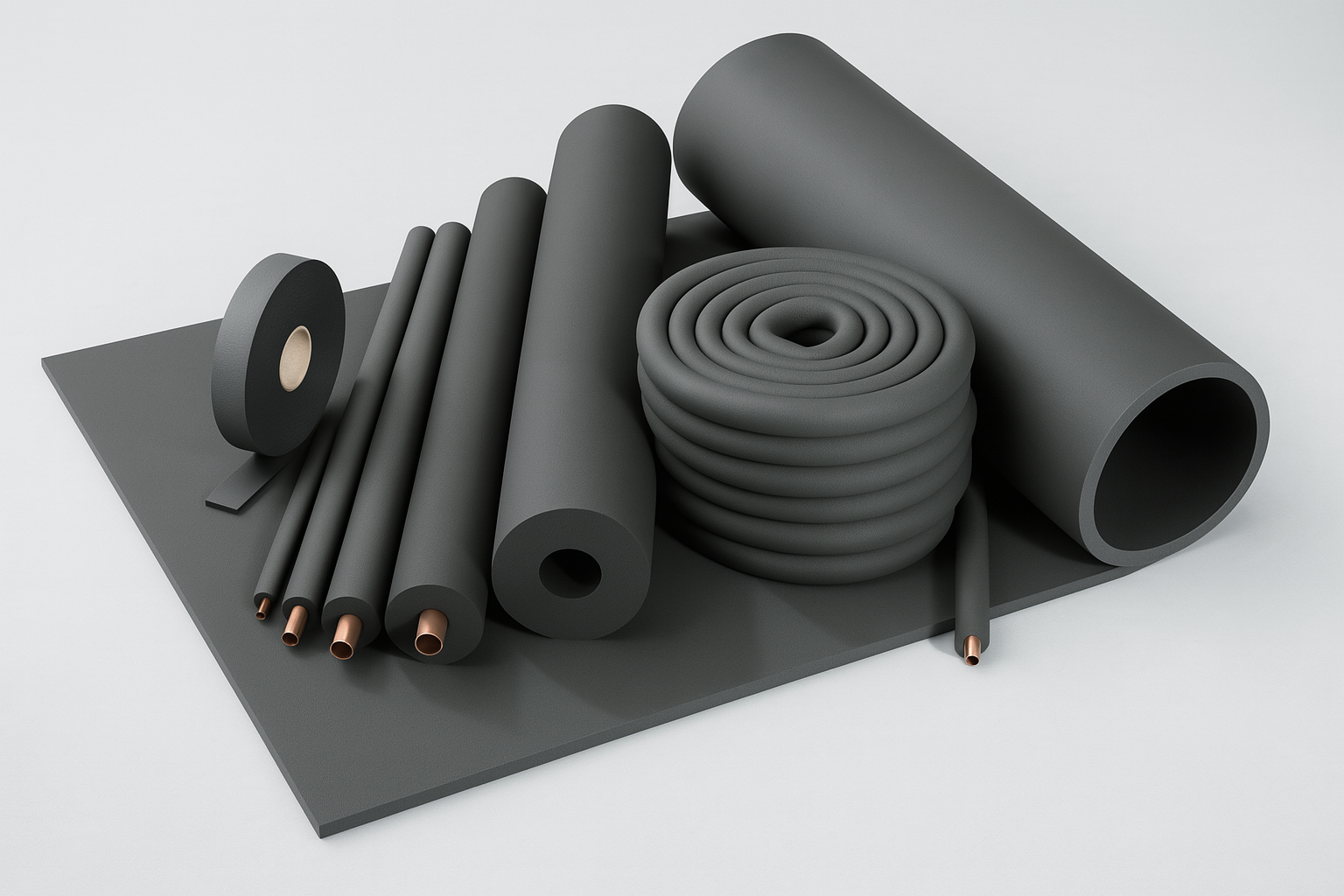
Stating that preserving the cell structure is of great importance, particularly in closed-cell insulation materials such as elastomeric rubber foam, Akdaş also drew attention to the effect of moisture on insulation performance:
“Moisture is one of the issues that requires particular care, especially in cold installations. Moisture penetrating into the insulation material does not only create a condensation problem. It can also cause the material’s thermal conductivity properties to change over time and, as a result, adversely affect the energy performance of the system. For this reason, insulation engineering for us is not just about achieving a low thermal conductivity value. The real engineering lies in ensuring that the performance achieved is maintained for as long as possible under real operating conditions.”
Right Material, Right Thickness, Lasting Performance
Stating that their core approach in developing Dynaflex products is built on the principle of “Right Material → Right Thickness → Lasting Performance,” Akdaş noted that every installation should be evaluated according to its own operating conditions.
“The operating conditions of every installation are different. Fluid temperature, ambient temperature, relative humidity, pipe diameter, indoor or outdoor conditions and the operating time of the system must all be evaluated together when determining the right insulation solution. That is why we believe that simply producing a good insulation material is not enough.”
Underlining that the right product selection must be complemented by the right thickness and the right application, Akdaş went on to say:
“The right material needs to be applied at the right thickness and in the right way. Only when these three elements come together can a true insulation system emerge, one that reduces energy losses, controls condensation and maintains its performance for many years.”
“How Will It Perform in 10 or 15 Years?”
Stating that product certifications and laboratory tests will continue to be important for the future of the insulation industry, Akdaş said that long-term field performance should also be given greater consideration alongside them.
“In our industry, we naturally ask, ‘What technical values does this product have today?’ This is an entirely valid and necessary question. However, I think we need to add another question to it: ‘How will this product and this insulation system perform in 10 or 15 years?’ We believe that a long-term approach to quality will become far more important in the years ahead.”
Stating that re-examining insulation systems installed in previous years could provide important insights in this regard, Akdaş said, “Being able to measure how systems installed years ago are performing today, and to reveal their current condition through thermal cameras, surface temperature measurements and material examinations, could be extremely valuable for the industry. This approach could make long-term field performance more visible and measurable.”
Noting that they express Dynaflex’s approach in this area with the principle of “Tested in the Laboratory, Proven in Real Life,” Akdaş emphasized that true quality should not be limited to performance at the time of production:
“True quality is not only the quality measured on the day a product is manufactured. True quality is quality that can pass the test of time.”
From Initial Investment Cost to Life-Cycle Performance
Stating that rising energy costs, efforts to reduce carbon emissions and sustainability targets have further increased the importance of insulation, Akdaş said that insulation systems should no longer be regarded as an auxiliary element of facilities, but as an integral part of the energy system.
“Considering that a facility will operate for 30 years or longer, the energy loss caused by an insulation system that was incorrectly selected or that loses its performance over time can generate economic and environmental costs far exceeding small price differences at the initial stage.”
Stating that investment decisions should therefore not focus solely on the initial purchase cost of the product, Akdaş said:
“We believe the insulation industry needs to move away from the question ‘Which is the cheapest insulation material?’ and ask more often, ‘Which system will deliver the highest energy performance throughout its life cycle?’ Because insulation may be a product that is purchased once, but when applied correctly, the energy efficiency it provides continues for years.”
From Insulation to Insulation Engineering
Stating that the world is entering a new era in energy efficiency, Akdaş said that the role of insulation within sustainability and energy management will become increasingly important.
“When we consider the cost of energy, the reduction of carbon emissions and sustainability targets, we can no longer regard insulation as an auxiliary element of a building or installation. Insulation is an integral part of the energy system. Keeping the energy that is produced, transported or used within the system as much as possible is one of the fundamental elements of efficiency.”
Stating that they have built Dynaflex’s vision for the future on the approach of “High-Performance Insulation Engineering,” Akdaş concluded:
“For us, insulation is not just a material. It is an engineering solution that conserves energy, keeps condensation under control, contributes to the safe operation of installations and systems, and must be able to sustain all of this for years. In developing Dynaflex products, we see long-term performance as one of the fundamental elements of this approach.”