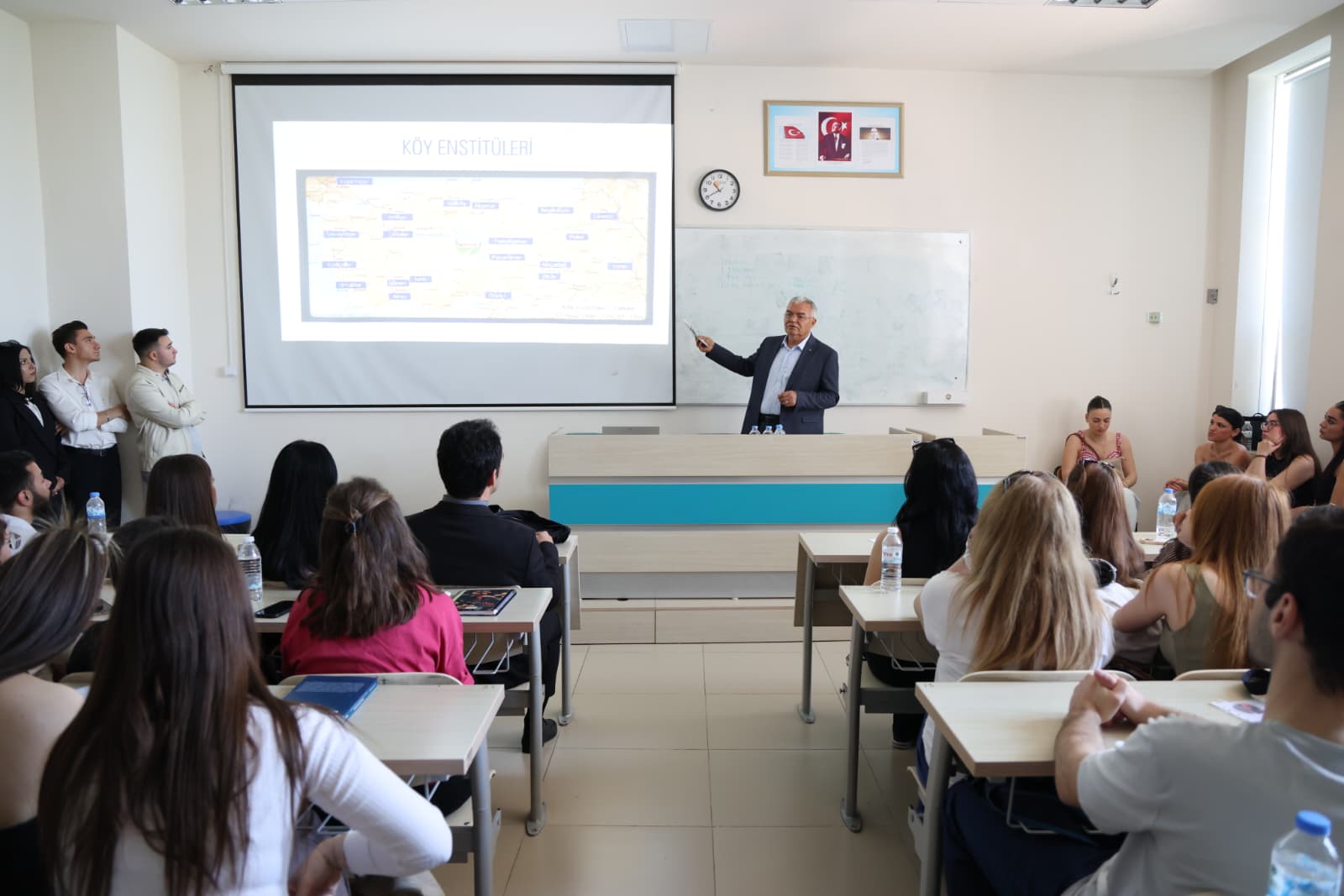
Metin Akdaş, Vice Chairman of the Board of EBSO, joined the “Sustainable Industry and Circular Economy” course at Celal Bayar University’s Faculty of Economics and Administrative Sciences as a guest speaker, giving students a wide-ranging presentation that extended from the expectations of the business world to the circular economy and production culture.
At the event, which drew great interest from students, Akdaş shared personal experiences with the young audience as advice for life. Emphasizing that determination matters more in life than one’s starting conditions, Akdaş said:
“I was born into a poor family in the village of Havuzlu in the Bor district of Niğde. My father was a shepherd. I started primary school with two failing grades, but I finished at the top of my class. Later, I went through very difficult times in my life; I was expelled from school, I lost my father, and there were moments when I came very close to giving up. But that is where life taught me its first lesson: No matter where you start, the outcome is in your hands.”
Stating that the business world’s greatest need today is qualified human resources, Akdaş drew attention to the need for young people to develop themselves not only through theoretical knowledge but also through hands-on experience in the field, saying:
“Türkiye’s problem is not unemployment, but a lack of vocational skills. Everyone in industry says the same thing: There is work, but there are no people to do it. The reason is very clear: education and production have become disconnected from each other. The business world no longer looks only at diplomas. It looks at whether a person has seen the field, can take responsibility, can adapt to teamwork and can come up with solutions when faced with a problem.”
Emphasizing that education and production need to be brought together more strongly, Akdaş shared a long-advocated approach, saying:
“I call this: Industry Institutes. In this model, education will take place within production. Students will be in the field. When they graduate, they will not look for jobs; jobs will look for them.
Young people will be trained not only in the classroom, but also in workshops, on production lines and within real working environments. They will not only learn a profession, but will also acquire a production culture by experiencing it first-hand. Because when they graduate, they will not be job seekers, but people who can apply knowledge and create value.”
Stating that sustainability is no longer merely an environmental discourse but a necessity that determines the future of the business world, Akdaş noted that resource management is one of the fundamental elements of the new era, saying:
“The world is no longer buying only products. It is also buying the way they are produced. How you produce, how you manage resources and how efficient you are in your production processes now matter as well. Sustainability today is not an abstract concept; it shows up in a factory’s energy consumption, in the scrap rate of a production line, in the recovery of a single drop of water and in the way a business plans its future.”
Stating that the circular economy gains meaning through practice rather than theory, Akdaş cited the practices they carry out at their companies as examples, saying:
“The real success is not recycling waste, but generating as little waste as possible in the first place. Because waste is not only an environmental issue; it also means wasted raw materials, energy, time and labor. That is why establishing the right chain of design, production and consumption is of great importance. The circular economy is precisely about not consuming and discarding resources, but keeping them within the system as much as possible.”
Addressing the students at the end of the talk, Akdaş emphasized that the future will need people who are not only knowledgeable but also able to create value, saying:
“Be people who ask. Be people who question. Be people who understand, not people who memorize. Be people who create not only ideas, but value. When you see a problem, do not say, ‘This is not my field.’ Because the problems you will encounter in life do not stay within the boundaries of a single discipline. Constantly improve yourselves, be curious, do research and stay open to learning. Because the people who will shape the future will not simply be those who possess knowledge, but those who can use that knowledge in the right place. I believe that you have the potential to achieve this.”
After answering the students’ questions at the end of the presentation, Akdaş was presented with a certificate of appreciation for the contribution by Prof. Dr. Cüneyt Yenal Kesbiç, faculty member at the CBÜ Faculty of Economics and Administrative Sciences and the instructor responsible for the course.